Our Mission & Governance
- Develop Malian and African research capacity on parasitic and microbial diseases through training and research;
- Produce high-level scientific results to advance scientific knowledge of pests and microbes and enable informed policy decision-making for the benefit of populations;
- Participate in the international effort to develop new drugs and vaccines against parasites and microbes;
- Build capacity for public health action on pest and microbe control;
- Strengthen basic research, applied research, clinical research.
- Pan-african Centre for Research and Training Excellence on Parasites and Microbes.
- For an Africa free of parasites and pathogenic microbes.
- Diversify research beyond malaria, including emerging and re-emerging diseases;
- Strengthen intra-EU collaboration, between faculties and other partners
- Energize the competitive teams/teams to be developed;
- Popularize the results of the research by creating a communication cell for visibility;
- Initiate projects based on the needs of the core population.• Initiate interdisciplinary projects;
- Revitalize the training offering for national structures;
- Work to integrate contract researchers into the public service;
- Create a website;
- Generate a critical mass of teachers: Professors/Conference Masters and Assistant Masters by CAMES/CNELA competition in the next 10 years;
- Obtain a standalone space;
- Develop at least one “Made in Mali” drug/vaccine (Phase I);
- Submit at least 5 patents;
- Create an office to evaluate research results.
The planned governance function of the centre is as follows:
G30: consolidating the Executive Board, Unit Heads and other Centre Officers when it comes to having a broader discussion for the proper functioning of the Centre.
The G10: brings together the Executive Board and the heads of the units around the table to identify the long-term objectives (strategic objectives) to be achieved by the Centre.
The Management: is the body responsible for operating the specifications defined by the bodies within the centre. As such, he is responsible for:
- the application of policy decisions
- day-to-day management
- representation of the group
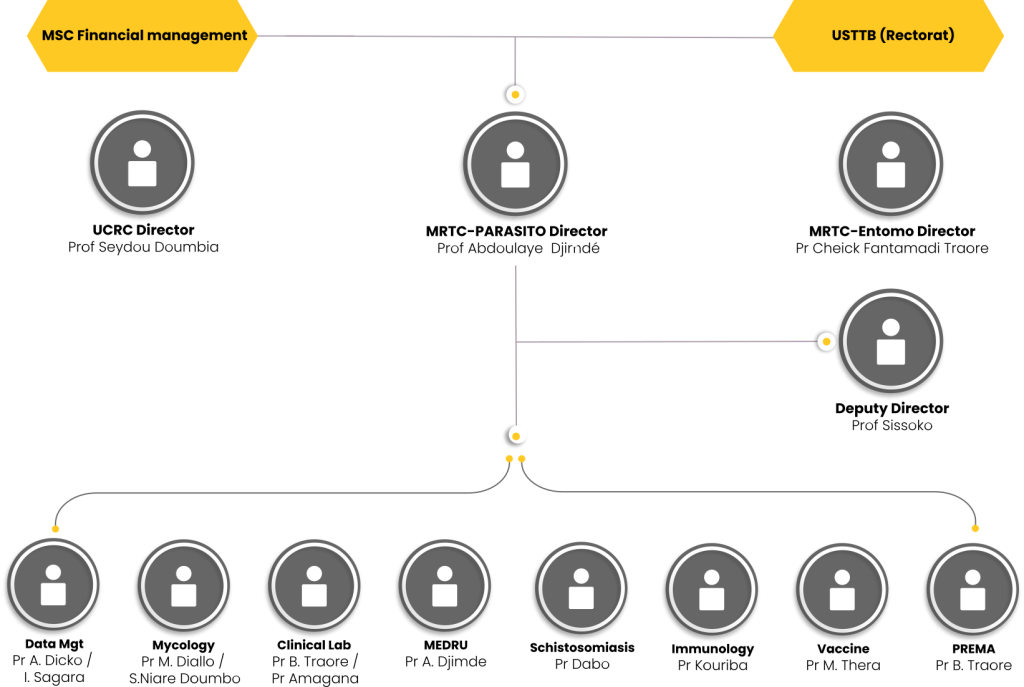
Organizational chart
Our partners